
By Rachel Kalera Mhango · 2026-09-10
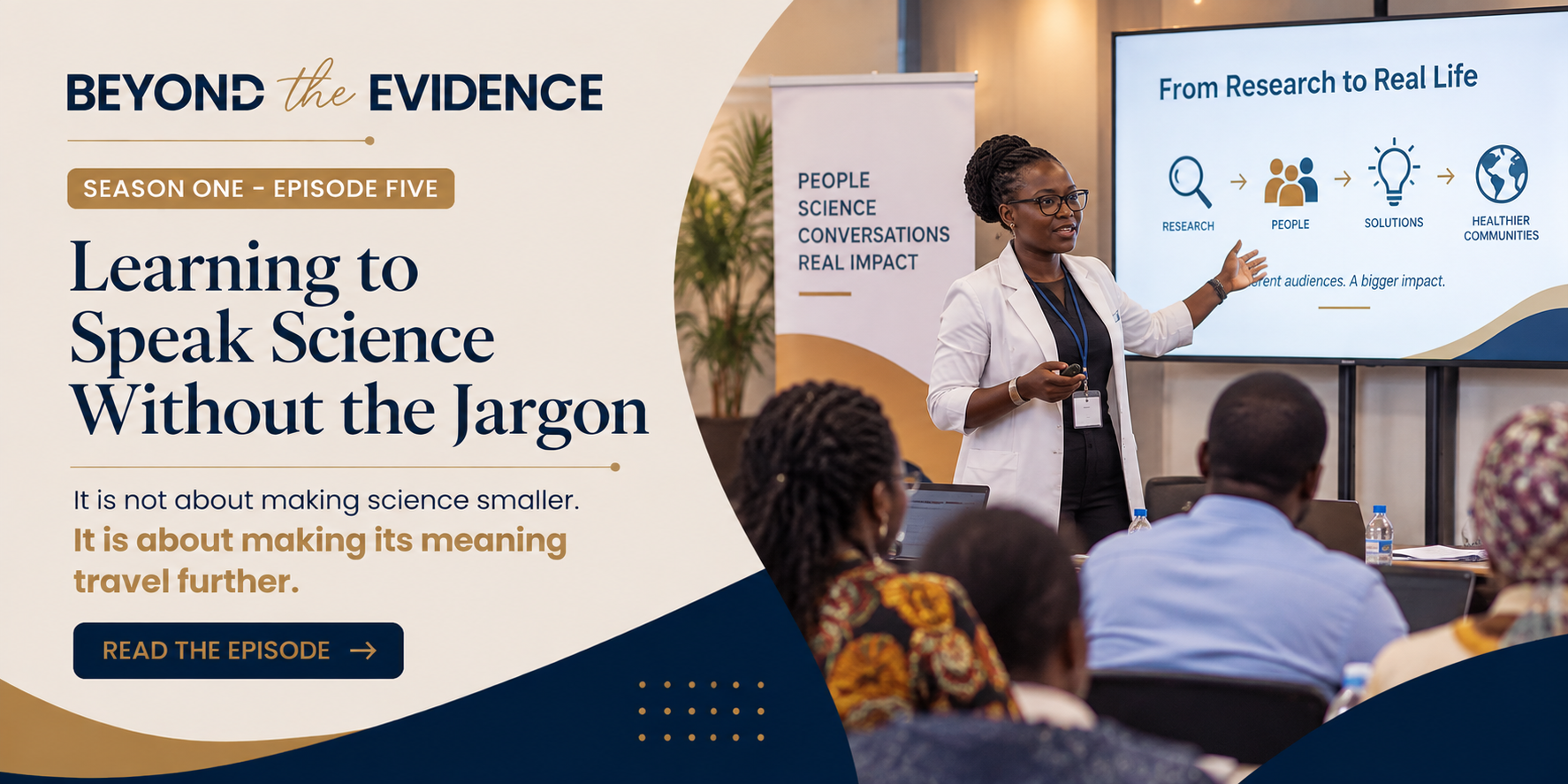
Learning to Speak Science Without the Jargon
At one point in my science communication journey, I thought: If I don't make an effort to ask scientists to simplify their topics and presentations, we are not going to get anywhere.
Not because the science was not important. It was. But what was the point of communicating important science if the people in the room could not understand what was being said? So I led an initiative to strengthen relationships between scientists and journalists. One objective was to help journalists better understand clinical research so they could report on it accurately and responsibly.
But something else happened along the way. The scientists were learning too. They began to appreciate that audiences extended beyond fellow researchers and academics. Study participants needed to understand what they were being invited to participate in. Communities wanted to understand why research was happening around them. Policymakers needed to make sense of findings and recommendations.
And there were journalists. Always looking for the story. But before they can tell that story, they need to understand what the science means.
I remember preparing for one of our half-day engagements between scientists and journalists. I had asked one of the scientists to present his study and findings. Before our planning meeting, I asked him to send me his topic and draft presentation. The title was something like: Intracellular Control Mechanisms of Mycobacterium tuberculosis within Human Lung Epithelium and Macrophages. I looked at it and thought: Aaah, Doctor. What is this? He politely told me, "That's my topic." Fair enough. But I knew immediately that we needed to have a conversation. When we met, I asked him one question: "If you were explaining this research to your grandmother, what would you tell her you are studying?" And he explained it. No complicated terminology. No scientific performance. Just a conversation about what he was trying to understand and why it mattered. Somewhere in that conversation, we found our title: Understanding Tuberculosis Control by Human Lung Cells. Suddenly, I could understand it.
And if I could understand it, I could begin asking questions. I could identify what might interest a journalist. A journalist could start to see the story. And eventually, an ordinary person could understand why the research mattered.
The science had not changed. The language had.
That experience reinforced something I would encounter many times in science communication. Scientific language exists for a reason. Precision matters. Terminology matters. And not every scientific paper is written for public consumption. But that does not mean scientific knowledge intended to influence people's lives should remain inaccessible. If research has implications for public health, policy, behaviour, practice or the adoption of an intervention, then at some point someone has to translate what that research means for the people expected to use it. And translation does not mean stripping the science of its accuracy. It means protecting the meaning while changing the language. That distinction matters.
Our engagements between scientists and journalists became important to me because we were not simply teaching journalists how science works but creating a space where two professions could begin to understand how the other works. Through this process, scientists could explain the evidence. Journalists could ask the questions an ordinary person might ask.
What does that actually mean?
Why should people care?
Who does this affect?
What changes because of this finding?
Those questions sometimes forced us to move away from terminology and toward meaning. And that is often where the story lives.
Nevertheless, there is a need to dispel the misconception that simplifying science means watering it down, because I don't believe it does. There is a difference between simplifying the language and oversimplifying the science. Our responsibility is not to remove complexity where complexity matters. Neither is it to replace scientific accuracy with catchy headlines. It is to understand the science well enough to identify what must remain precise, what needs explanation, and what can be expressed in language that makes sense to the intended audience. That requires work from both sides. Scientists need to recognise that understanding their research does not automatically mean knowing how to communicate it to every audience. Science communicators, on the other hand, cannot simply wait for scientists to hand them simplified information. We have to ask questions. Sometimes many questions. Sometimes the same question differently. And sometimes we have to say:
"Doctor, explain that to me again, but this time, imagine you are explaining it to your grandmother." Not because the grandmother lacks intelligence. But because expertise should never be the price of admission to information that affects people's lives.
Looking back, I learned enough science to ask better questions, recognise the meaning behind the terminology, and connect that meaning to the people who needed it. And perhaps scientists were learning something too. That communicating research beyond academia requires a different kind of skill. A research finding can be scientifically brilliant, methodologically rigorous, and potentially life-changing. But if the people who need that knowledge cannot understand what it means, we have not completed the communication journey.
Learning to speak science without the jargon is not about making science smaller. It is about making its meaning travel further.
And that, too, is science communication.