
By Rachel Kalera Mhango · 2026-09-01
The Missing Link Between Scientists and Society
Good science does not automatically lead to understanding.
We can have strong evidence, important discoveries, new technologies and potentially life-changing innovations. But somewhere between the scientist who produces the knowledge and the society expected to understand, trust or use it, something can get lost.
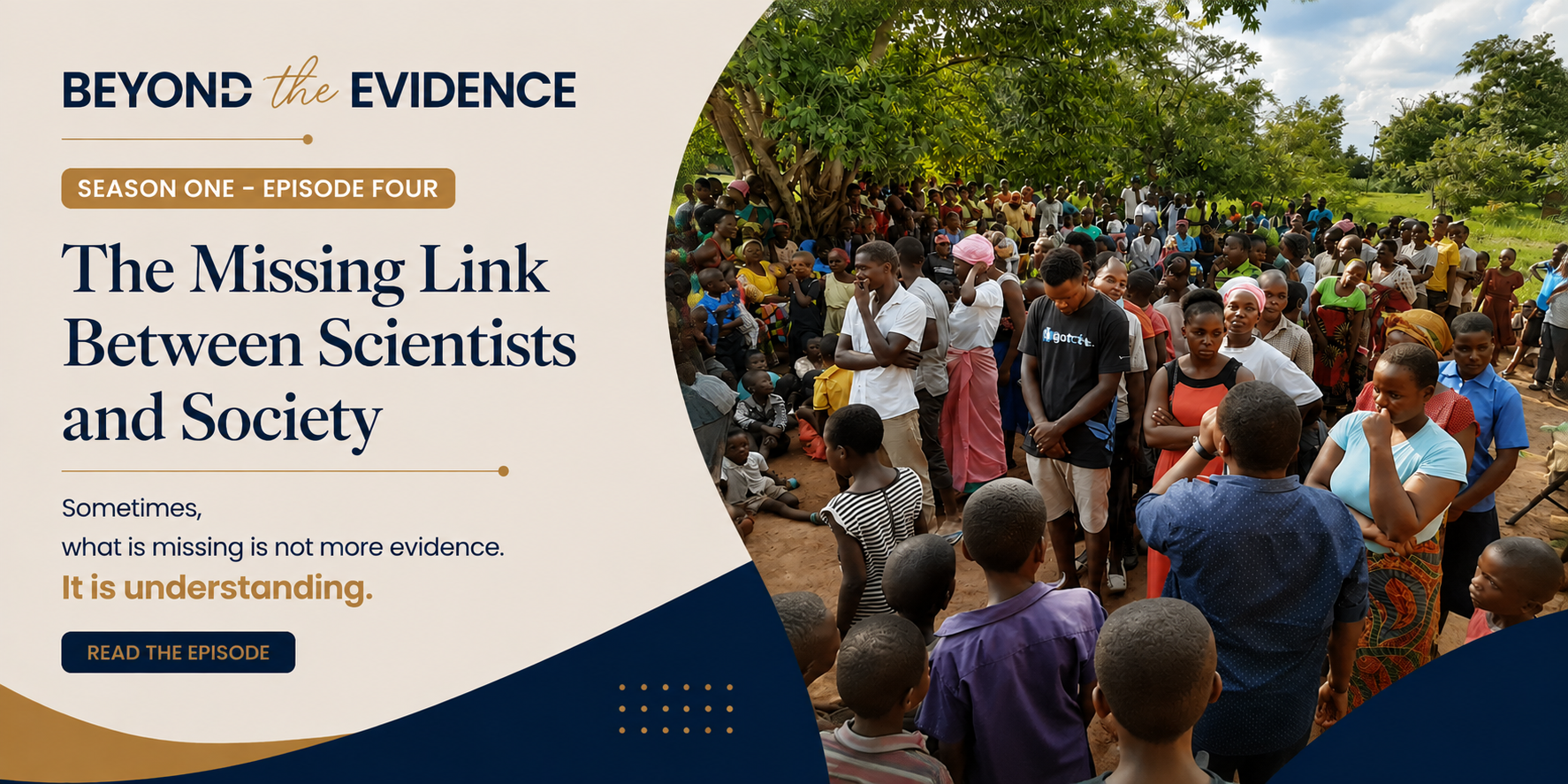
Sometimes, what is missing is not more evidence. It is understanding.
After reflecting in my previous episode on why research participants are more than numbers, I found myself thinking about what it really means to understand the people we communicate science to. Who are they? What language do they speak, and, more importantly, what do their words mean within their context? Who do they listen to and trust? What are their experiences, challenges, cultural practices and religious beliefs? What do they already know?
These questions matter whether we are communicating health research, agricultural science, climate science, energy, engineering or any other form of scientific knowledge. Before we throw scientific information at people, we need to understand the world that information lands in.
When the Same Words Mean Different Things
One of the simplest examples I have encountered happened at a health facility in rural Lilongwe. A mother rushed to the facility with her child. When the health personnel asked what had happened, she explained in Chichewa: "Mwanayu wadya ka msomali." The health workers understood her to mean that the child had swallowed a nail. Naturally, there was panic. Other health personnel were called in as they tried to establish what needed to be done. They asked the mother again, and she repeated the same explanation. Meanwhile, she was equally surprised by the commotion around her. Eventually, as they tried to reconstruct what had happened, the mother demonstrated what she meant. The child had stepped on a nail. The words had been heard correctly. But she understood the meaning differently. In one context, wadya relates to eating. But language is shaped by locality, usage and context, and the expression the mother used carried a different meaning where she came from. I have always found this example fascinating because nothing particularly scientific went wrong. Nobody necessarily failed to listen. The missing piece was context.
And if such a misunderstanding can happen in a simple conversation between a mother and a health worker, imagine what can happen when we communicate clinical research, diagnoses, medicines, vaccines or other complex scientific information.
This is why language justice is about more than translating information from English into Chichewa, Tumbuka or another local language. Translation gives us words. Context gives those words meaning.
When Scientific Knowledge Meets Lived Knowledge
During one of my Science Communication classes, a student shared another example, this time from agriculture. Experts had introduced an agricultural innovation to a community, but farmers were reluctant to adopt it. From the outside, it could easily have looked like resistance to science or an unwillingness to change. But there was more to the story. The agricultural field officers working with the community were relatively new graduates. They had scientific and technical knowledge, but the farmers felt they didn’t fully understand the area’s farming conditions.
Some of those farmers may not have had formal scientific training, but they had farmed that land for years. They understood their soil. They understood the seasons. They knew which crops had performed well and under what conditions. They carried knowledge built through lived experience. The scientific innovation may have been good. But something was missing between the experts' knowledge and the knowledge already in the community.
Perhaps the starting point should not always be: How do we convince people to adopt this innovation? Perhaps we should first ask: What do they already know that we need to understand? That small shift changes communication from telling to listening. And listening is also part of science communication.
When Evidence Reaches the Policymaker but Not the Person
The same problem exists at another level. We often talk about policy briefs as an important way to get research evidence into policymakers' hands. But getting a document onto someone's desk or into their inbox is not the same as communicating evidence. I remember attending a science café organised by Kamuzu University for Health Sciences where the Minister of Local Government, Ben Phiri, raised a concern about the language scientists use when communicating with policymakers. His point was simple: scientists sometimes write policy briefs as though they are writing for other scientists. The evidence may be there. The recommendations may be there. The document may technically be called a policy brief. But can the policymaker quickly understand what matters, why it matters and what needs to be done?
During that discussion, Professor Adamson Muula also reflected on how deeply meaning is connected to language and context. He gave an example familiar to many Malawians. When someone who has been critically ill dies in hospital, relatives may call another family member and simply say: "Achimwene, paja tinali ku chipatala, dzibwerani." Brother, you know we were at the hospital. Please come. Nobody has explicitly said, "They have died." Yet depending on the context, the person receiving that call may already understand what "dzibwerani" means.
Two words. A much bigger message. That is context.
And it reminds us why communicating science cannot simply be about replacing technical words with supposedly simpler ones. We must understand meaning.
So, Where Is the Missing Link?
There isn't only one. It can be language, culture, religious belief, trust, the messenger or the failure to recognise existing community knowledge. And sometimes, it is simply our failure to listen before we communicate. Scientists and health workers have an important role in closing that gap. But so do science communicators. Our responsibility is not merely to receive scientific information at the end of the research process and make it "simpler. Many links between science and society are missing, and I hope to unpack more of them as this series continues. For now, we should begin with something that sounds simple, yet is often overlooked: Understand the context. Because good science can produce evidence. Good communication can make that evidence accessible. But meaningful engagement helps us understand the people whose lives that evidence is intended to change.
And sometimes, that is the missing link between science and society.